
According to a recent industry analysis by Future Market Insights, the 2025 global advanced air mobility market was valued at approximately USD 13.9 billion, reflecting growing investment not only in aircraft development but also in the operational frameworks, infrastructure, and regulatory systems required for real-world deployment. This growth is being driven by expanding applications in cargo transport, emergency services, and public sector operations as governance and technology mature.
Advanced air mobility is not a single technology challenge. eVTOL adoption depends on many moving parts progressing together: aircraft performance, autonomous flight software, operational approvals, payload integration, maintenance pathways, and the airspace services that make routine flights possible.
That is why partnerships are driving the industry forward. When aircraft developers, operators, regulators, research teams, and system suppliers collaborate early, the feedback loops get shorter, the learning happens in real environments, and new capabilities reach operational readiness faster.
At Dufour Aerospace, we are building an ecosystem around practical, mission-driven eVTOL operations. Our work focuses on critical logistics and public service missions where time matters, access is limited, and cost efficiency must go hand in hand with safety. Partnerships are how we turn technical progress into deployable capability, and how we help accelerate eVTOL adoption across markets.
eVTOL aircraft are designed to operate in complex environments where safety, efficiency, and reliability must be proven simultaneously. Scaling these capabilities into everyday operations depends on effective ecosystem collaboration.
Operator partnerships bring access to real mission scenarios, exposing aircraft to operational constraints such as weather, terrain, logistics workflows, and regulatory interfaces. Research collaborations strengthen the technical foundations of autonomy and flight control, ensuring systems are robust across all phases of flight. Engagement with airspace stakeholders and industry bodies helps align technical progress with the realities of U-space and uncrewed traffic management frameworks. Payload and systems partners transform aircraft into mission platforms capable of serving real customers.
Together, these collaborations accelerate learning, improve decision-making, and create the confidence required for wider eVTOL adoption.
Throughout 2025 and into 2026, Dufour Aerospace has focused on partnerships that directly support operational readiness and ecosystem maturity.
Our strategic teaming agreement with Volatus Aerospace is a clear example of how collaboration accelerates deployment. By combining Dufour Aerospace’s tilt-wing eVTOL technology with Volatus Aerospace’s operational expertise and global reach, this partnership strengthens the pathway toward scalable aerial cargo, inspection, mapping, and surveillance services. It connects aircraft capability to real market demand and operational control concepts, which are essential for adoption beyond isolated demonstrations.
“My confidence in the technology of Dufour Aerospace not only comes from having seen the Aero-200 in action, but even more importantly, having met the brilliant team of professionals behind the technology. Adding the Aero-200 to a growing fleet of larger, more capable drones extends our capabilities and accelerates the commercialization of our Operations Control Center and remote operations capabilities,” said Glen Lynch, CEO of Volatus Aerospace.

Operational partnerships in demanding environments further reinforce this approach. Continued collaboration with Air Zermatt allows Dufour Aerospace to prepare hybrid electric aviation for mission-critical settings where safety margins, performance, and operational discipline are non-negotiable.
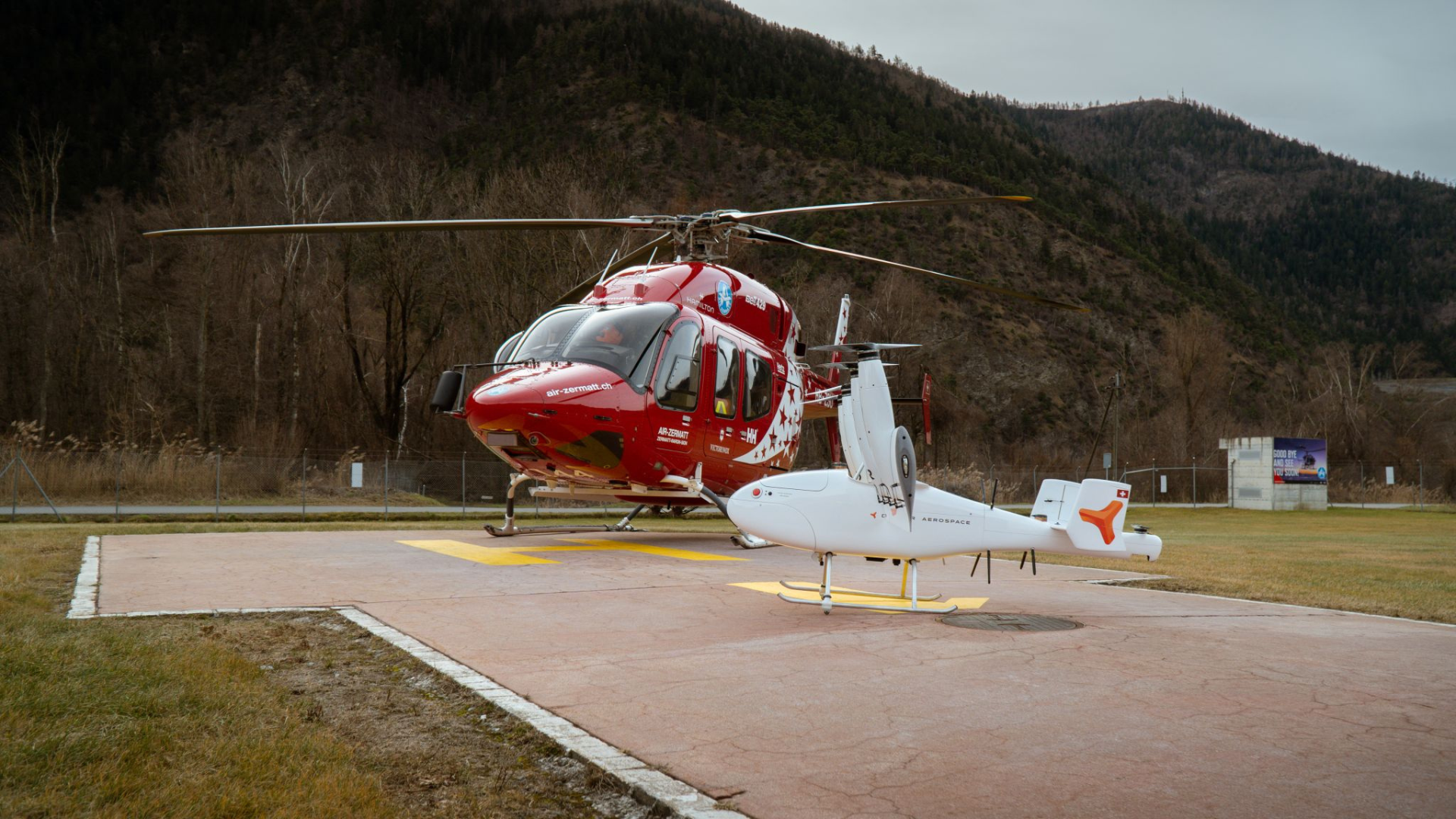
“With Dufour Aerospace, we are exploring the benefits of drones in challenging mountainous environments to serve our population. This partnership allows us to remain focused on our strengths and widen our scope of activities at the same time,” said Daniel Aufdenblatten, CEO of Air Zermatt.
Similarly, long-range medical logistics simulations with our Scandinavian partners Savback Helicopters have supported shore-to-shore mission scenarios, validating endurance, range, and operational workflows that reflect real service requirements.

“The innovative approach of Dufour Aerospace takes the best of aviation engineering and certification experience and complements our existing activities around helicopters perfectly. Many operators are looking for more efficient solutions, and Dufour Aerospace has identified the sweet spot,” said Michael Savbäck, Owner and CEO of Savback Helicopters.
Healthcare partnerships demonstrate the societal value of eVTOL adoption. Supporting France’s first medical graft transport by drone, together with Leeft, CHU de Nantes, and other partners, showed how complex, time-critical missions can be enabled through close coordination between aviation, healthcare, and research stakeholders. These missions generate operational insight that feeds directly back into aircraft development and system design.
Technology and payload collaborations also play a decisive role. The successful integration and flight testing of a RIEGL LiDAR system on a Dufour Aerospace tilt-wing platform, alongside partners BSF Swissphoto and the WSL Institute for Snow and Avalanche Research SLF, demonstrated how high-value commercial sensors can be deployed efficiently on large drones. Validating real payloads in operationally relevant conditions accelerates adoption by expanding viable use cases and strengthening the commercial proposition.

Beyond operations and technology, strategic partnerships shape long-term execution. Multi-day strategy workshops with Murzilli Consulting have helped align vision, regulatory realities, and development priorities.
.jpg)
Research collaborations with academic teams, including autonomous mission concepts developed with ETH Zurich students, support early exploration while reinforcing the link between simulation, control architecture design, and real-world resilience.
Partnerships do not form in isolation. Industry platforms provide shared spaces where alignment happens faster.
Events such as GUTMA’s Harmonized Skies bring together regulators, service providers, and industry leaders to advance practical approaches to U-space and uncrewed traffic management. These conversations are essential for making routine eVTOL operations feasible, not just technically possible.
.png)
Aerial Cities 2025, hosted at Dublin City Hall in collaboration with Dublin City Council and the Irish Aviation Authority, provided a clear example of ecosystem-level collaboration. The invitation-only event brought together more than 170 C-level experts from across the drone and advanced air mobility industry, with over 60 speakers, 15 civil aviation authorities, and representatives from more than 15 cities and governments. Across 13 strategic sessions, discussions addressed concrete operational topics including Part 108 ADSP frameworks, the transition to eVTOL and vertiport infrastructure, global supply chain manufacturing, BVLOS connectivity through satellite and cellular integration, the commercial realities of U-space, and the drivers of profitability and social acceptance in drone operations.

Field demonstrations and operational showcases play a complementary role. In 2025, Dufour Aerospace participated in multiple public demonstrations designed to expose aircraft to real-world scrutiny rather than controlled test conditions.
At UAS Forum Sweden, held at Västervik Drone Science Park during Sweden’s Investor Week, Dufour Aerospace conducted the first public flight demonstrations of the Aero-200 tilt-wing drone outside Switzerland. Multiple flights were performed, including a live demonstration in front of more than 150 spectators, supported by a cross-border visual line of sight approval from the Swedish Transport Agency. The event brought together stakeholders from advanced air mobility, infrastructure, and investment communities, providing a forum to discuss long-range logistics, remote sensing, and operational readiness in a regulatory environment actively supporting uncrewed aviation.
In the United States, Dufour Aerospace supported its customer Areion at the AUVSI Cascade Spring Symposium in Pendleton, Oregon, hosted at the FAA-approved Pendleton UAS Test Range. The event convened leaders from government, emergency services, aerospace, and industry to explore the future of uncrewed aviation. Aero-200 was showcased through static display and operational discussions focused on critical cargo, remote sensing, endurance, and modularity. Engagements at Pendleton emphasized how aircraft performance, operational support, and regulatory access must align for real deployment.

Looking ahead, the International Drone Show 2026 in Odense will continue this momentum. Under the leadership of CEO Sascha Hardegger, Dufour Aerospace will share how a unified autonomous flight control architecture has been developed and validated from simulation through full-scale autonomous flight testing. Building on demonstrations and campaigns conducted across multiple countries in 2025, these sessions highlight how transparent testing, operational exposure, and ecosystem dialogue contribute to certifiable and resilient eVTOL systems.
Beyond aircraft, Dufour Aerospace is building an ecosystem designed to support critical missions where trucks cannot reach, helicopters are too costly, and time is of the essence.
Our Aero-200 tilt-wing eVTOL aircraft is designed for logistics and public service missions, combining vertical takeoff capability with efficient fixed-wing flight and a hybrid electric powertrain. But its adoption depends on much more than design choices. It depends on trusted operators, integrated payloads, aligned airspace frameworks, and autonomous systems that perform reliably outside controlled test environments.
That is why partnerships sit at the core of our strategy. Each collaboration strengthens the network required to move advanced air mobility from concept to operation, reducing friction, improving safety, and accelerating deployment at scale.
As advanced air mobility enters its next phase, eVTOL adoption will increasingly be defined by ecosystem maturity rather than isolated breakthroughs. The companies that succeed will be those that collaborate early, learn in real environments, and align technology development with operational and regulatory realities.
At Dufour Aerospace, we will continue to invest in partnerships that turn progress into practice and innovation into impact, helping eVTOLs deliver on their promise for critical missions worldwide.
Dufour Aerospace is pioneering drones for critical missions. Based in Switzerland, Dufour Aerospace develops and manufactures efficient and sustainable aircraft for cargo transportation, logistics, and public safety. The Aero-200 drone features distributed electric propulsion and a hybrid module to meet today’s Advanced Air Mobility and medium-sized drone market requirements.
Contact: media@dufour.aero
More info: www.dufour.aero
Visit site:
ABOUT DUFOUR AEROSPACE:
Dufour builds the scalable operating layer for automated aerial logistics. We integrate DufourAircraft as high-integrity flying assets with DufourOS – the software multiplier enabling remote fleet supervision from centralized control centers. The result is a scalable aerial logistics network: automated, route-based air freight operated day and night.
